
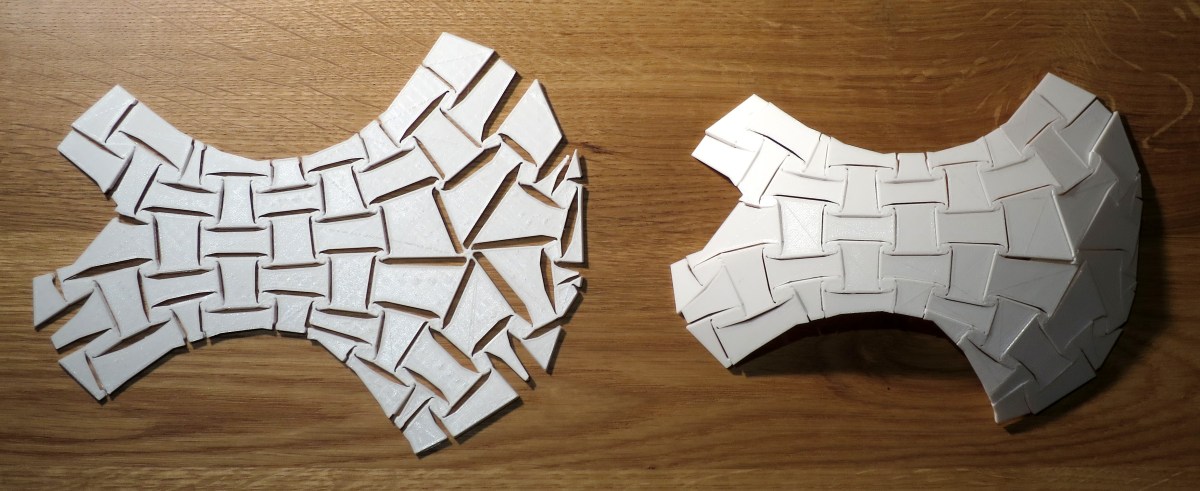
Part of PhD research, November 2017 – October 2018
After months of revision, my second peer-reviewed journal paper “Programming Flat-to-Synclastic Reconfiguration” is released.
This research is the extension of the paper presented in the AAG 2018 conference. The previous one mainly focuses on using individual bi-stable units to connect panels in various gap-widths and bending-angles. While this one further explains how to apply the bi-stable auxetic pattern to free-form synclastic meshes.
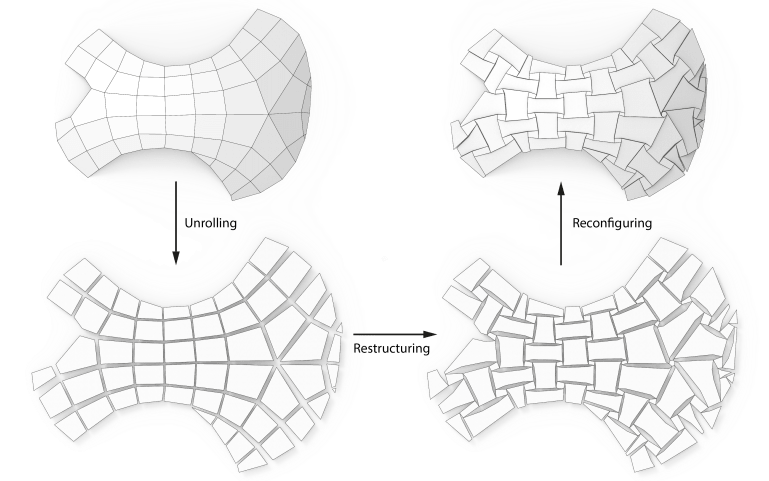 The workflow of the design process
I wrote semi-automatic MATLAB codes to generate the connectors and produce G-code for waterjet cutting. Although the analyses are complex, the curved surface can easily be assembled right after waterjet cut. Here are the timelapse of the production and the demonstration of the reconfiguring.
I have to express my gratitude to OH Precision Corporation and their helpful engineers and managers. They granted me the access to the CNC waterjet and taught me how to operate it.
For people who are wondering where I got the inspiration, I selected few interesting references.
In the coming months, I will work on implementing the reconfigurable mechanisms to erect a research pavilion. I hope there will be some positive news to share with you soon.
Chiang, Y.-C. (2019). Programming Flat-to-Synclastic Reconfiguration. archiDOCT, 6(2), 64-79.


This is very cool! Could this technique be used for semi-regular planar tilings like this: http://methodart.blogspot.com/2011/08/another-experiment-with-generating-semi.html
LikeLike
Nice work, Kevin!
Regarding whether or not the reconfigurable mechanism can apply to the planar tilings you mentioned. First of all, I have to say it is ongoing research, which means I have not exhaustively identified its capacity yet. What I can say is that the technique can only apply to the panels with even-sides (quadrilateral, hexagon, octagon…). And due to some geometrical challenge, I have only the solver for synclastic surfaces. The solution to “flatten” anticlastic surface do exist, but I have no solver to flatten an arbitrary anticlastic surface yet.
Considering the planar tiling you suggest has pentagons, which cause incompatibility. And the tiling also contains anticlastic parts, will make it quite challenging for now.
I hope explanation helps, let me know if you like any further clarification.
LikeLike